
Health promotion
According to the Health promotion glossary of terms (2021), "Health promotion is the process of enabling people to increase control over, and to improve their health."
Health is created where people live, learn, work, play and age. It is shaped by decisions about public policy, investment, living and working environments, access to information and opportunities – many of which are made outside the health sector.
The Ottawa Charter for Health Promotion, adopted at the First International Conference on Health Promotion in 1986, set out this approach. It identified three strategies – advocate, enable and mediate – and five action areas: building healthy public policy, creating supportive environments, strengthening community action, developing personal skills and reorienting health services.
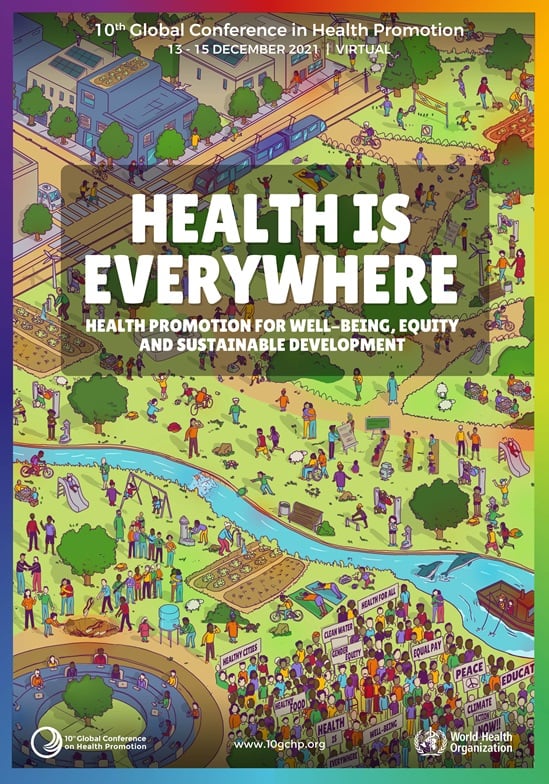
Successive Global Conferences on Health Promotion have built on the Charter. The Shanghai Declaration (2016) linked health promotion to the Sustainable Development Goals. The Tenth Global Conference (virtual, December 2021), on health promotion for well-being, equity and sustainable development, adopted the Geneva Charter for Well-being, which calls for well-being societies that prioritize health, equity and sustainability.
Today, health promotion helps societies respond to climate change, widening inequalities, economic insecurity and digital transformation. It also helps place health, well-being, equity and sustainability at the centre of how progress is defined and measured, alongside economic growth. This requires meeting the needs of people today, within planetary boundaries, while safeguarding the conditions that future generations will need to thrive.
WHO's work on health promotion builds on the Ottawa Charter for Health Promotion (1986) and the declarations and charters of the Global Conferences on Health Promotion that followed, most recently the Shanghai Declaration (2016) and the Geneva Charter for Well-being (2021).
It is guided by the WHO Fourteenth General Programme of Work, 2025–2028 (GPW 14). Its overarching goal is to promote, provide and protect health and well-being for all people, everywhere.
Health promotion contributes directly to GPW 14 strategic objective 2 – to address health determinants and the root causes of ill health in key policies across sectors – and in particular to joint outcome 2.3: populations empowered to control their health through health promotion programmes and community involvement in decision-making.
It is also guided by Member State decisions, including:
- Resolution WHA75.19 (2022) on well-being and health promotion, which requested WHO to develop a framework on achieving well-being; and
- Decision WHA76(22) (2023), by which the Seventy-sixth World Health Assembly adopted “Achieving well-being: a global framework for integrating well-being into public health utilizing a health promotion approach”.
WHO's “Implementing the global framework on well-being at country level: policy pathways” (2025) sets out practical pathways for ministries of health to work across government and with other partners to put the framework into action.
WHO supports countries to advance policies and programmes that promote health, equity and well-being, placing them at the centre of policy, investment and measurement across government, working with communities, civil society, academia and partners.
WHO puts the principles of the Ottawa Charter for Health Promotion into practice through four interconnected areas of work, focused on the policies, systems and societal conditions that shape health and well-being for all.
Healthy public policy and whole-of-government action
Health depends on decisions made across government. WHO promotes intersectoral governance for health and well-being across and between levels of government – including Health in All Policies, well-being frameworks and action on the determinants of health – so that health, equity and sustainability are considered in policy, budgeting and the measurement of progress.
Health literacy
Health literacy enables people to find, understand and use information to make decisions about their health. WHO supports countries to strengthen health literacy at personal, organizational and systemic levels and across the life course, including in digital environments, and to make health systems and services easier to navigate. This includes helping countries to assess, monitor and report on health literacy using global measurement tools, building the health literacy capacity of health professionals, and developing tools to support the implementation of health literacy interventions.
Healthy settings
Healthy settings apply health promotion where people live, learn, work and play (e.g. cities and communities, schools and universities. WHO supports cities and local governments to act on the determinants of health; Healthy Cities remains the best-known example, alongside health-promoting schools.
Community engagement and social participation
People and communities have the right to have a say in the decisions that affect their health and well-being. WHO supports countries to strengthen community engagement and social participation in setting priorities, allocating resources and designing, delivering and evaluating policies and services, strengthening trust, accountability and equity in health.